Retail buyers and category managers in the outdoor and family-travel sectors face shifting consumer demands. Modern families constantly seek functional gear solving multiple logistical challenges at once. Parents feel deeply fatigued by managing fragmented equipment during weekend hikes, busy park visits, or co-parenting handoffs. Juggling separate lunch boxes, loose water bottles, and bulky school bags creates daily chaos.
The emergence of the hybrid 2-in-1 kids bottle bag and backpack combination offers a powerful solution. This integrated design merges hydration, nutrition, and essential storage into a single streamlined unit.
This guide evaluates the commercial viability, essential design specifications, and objective trade-offs of integrated kids' outdoor bags. You will gain a clear decision-making framework to drive smart retail line expansion. By understanding core material standards and functional limits, merchandisers can confidently stock products matching true consumer intent.
Key Takeaways
Consolidation Drives Conversion: Integrating insulated food compartments and secure bottle holders directly into a backpack reduces the "number of items to carry," a primary purchasing trigger for parents.
Material Durability is Non-Negotiable: Top-performing SKUs utilize 600D polyester and EVA materials to withstand rough handling ("kids are rough on their stuff").
The Capacity Compromise: Built-in bottom compartments reduce vertical space in the main compartment, often making it difficult to fit standard hard-shell A4 binders without bending corners.
High Cross-Sell Potential: Pattern-matching ecosystems (matching bags, bottles, and ice packs) significantly increase Average Order Value (AOV).
Why the "2-in-1 Kids Bottle Bag" Hybrid is Winning Market Share
Active families frequently struggle to maintain high-frequency water access. Children easily lose loose accessories during trail hikes or playground transitions. Most traditional backpacks lack dedicated, upright liquid storage. Water bottles tumble out easily. Sometimes they leak onto expensive electronics inside the main compartment.
Merging a backpack with a built-in insulated compartment actively solves this consumer pain point. Children can carry their gear entirely hands-free. This "less to carry" proposition removes the massive logistical headache of family day trips. It also simplifies overnight caretaker handoffs. Parents love knowing every essential item sits safely securely in one place.
These hybrid designs successfully bridge a major market gap. They sit perfectly between a basic academic school bag and a highly technical boys outdoor backpack. This positioning captures a highly lucrative demographic. Manufacturers cater directly to growing family-hiking and outdoor recreation markets. Retailers see higher conversion rates when positioning these items as active lifestyle solutions. They solve real-world parenting frustrations rather than merely offering aesthetic updates.
Consumers prioritize mental relief during travel. Reducing the sheer number of physical items a family must track directly improves their outdoor experience. Bags eliminating extra hand-carried lunch boxes win over fatigued parents. This psychological relief directly drives rapid market share growth.
Core Evaluation Dimensions for Retail Merchandisers
Retail merchandisers must carefully evaluate specific dimensions before committing to new inventory. Buyers need reliable benchmarks to compare different product iterations.
Optimal sizing targets children aged five and older. Standard dimensions typically hover around 17 inches long, 11 inches wide, and 8.5 inches deep. This yields a helpful volume of roughly 20 to 21 liters. Weight limits remain a critical ergonomic factor. Empty bags must balance tough durability against child comfort. Ideally, the bag weighs no more than 1.5 lbs. Heavy designs lead to poor posture and generate immediate parental complaints.
Material compliance dictates product longevity. Exterior fabrics demand water-resistant 600-denier (600D) polyester or non-toxic nylon. These thick weaves handle harsh outdoor abrasions and inevitable liquid spills perfectly. Interior cooling zones require food-grade, easy-to-wipe EVA polyester. This ensures insulated areas remain hygienic long after messy food storage.
Ergonomic mandates actively guide safe product selection. Padded back panels distribute loaded weight evenly. Adjustable contoured shoulder straps comfortably accommodate rapidly growing bodies. Optional chest straps, also known as sternum straps, stabilize dynamic weight during vigorous outdoor activities.
Specification Benchmark Table
Evaluation Criteria | Target Standard | Retail Importance |
Dimensions | 17” L x 11” W x 8.5” H | Fits ages 5-10 comfortably without overwhelming small torsos. |
Volume | 20 - 21 Liters | Provides sufficient space for daily outdoor gear and snacks. |
Empty Weight | Max 1.5 lbs | Prevents shoulder strain and meets basic ergonomic safety guidelines. |
Exterior Material | 600D Polyester / Nylon | Offers high abrasion resistance against rocks, pavement, and snags. |
Interior Material | Food-grade EVA | Allows quick wipe-down cleaning and prevents mold growth. |
Solving the "Drop Risk": Advanced Bottle Storage Mechanisms
Standard one-third-height mesh side pockets contain a massive structural flaw. They routinely fail to secure taller modern hydration vessels. Popular 40oz stainless steel containers easily topple out. When children bend over to tie their hiking boots, heavy bottles inevitably slip.
These frequent drops dent expensive insulated flasks. They also pose a frustrating safety risk on rocky trails. Broken bottle caps lead to immediate hydration emergencies during remote trips.
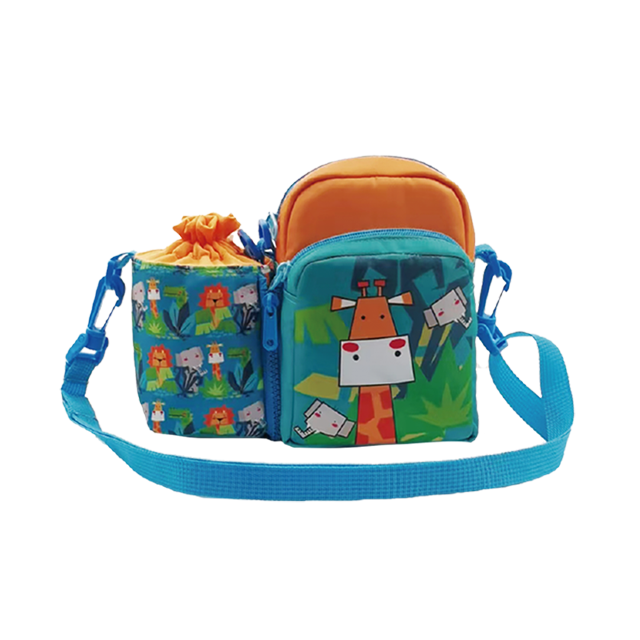
Industry leaders now utilize a dedicated kids kettle backpack approach. Designers engineered advanced storage mechanisms to eliminate this drop risk entirely. Buyers must look for explicit structural upgrades.
Let us examine the two primary engineering solutions:
Drawstring and Toggle Systems: External bottle sleeves incorporate a robust cinch-top closure. This mechanical locking system ensures the container remains firmly in place. Even if the child turns the bag entirely upside down, the bottle stays secure.
Deep-Pocket Engineering: Upgraded designs utilize tall, two-thirds-height elasticized pockets. They offer a sleek, highly integrated alternative to hardcore modular systems. Tactical MOLLE webbing often looks too aggressive for young children. Deep pockets remain highly consumer-friendly while retaining excellent functional security.
These specialized features prevent costly damage. They also guarantee immediate hydration access without requiring adults to unpack main compartments.
The Design Trade-Off: What Buyers Must Know Before Stocking
Every integrated product design carries specific functional trade-offs. Buyers must deeply understand these limitations to prevent high return rates. Transparency sets correct consumer expectations from the start.
The most prominent challenge involves the "binder issue" or internal volume cannibalization. Because the hybrid design features a built-in, structured insulated compartment at the base, it pushes the internal floor upward. This structural shift compromises the vertical height available in the main storage area.
Consumers often find they cannot lay standard A4 hard-shell binders flat. If children force rigid binders inside, the corners bend, warp, and potentially damage the bag lining. Retailers must proactively position these bags for specific use cases. Market them for outdoor exploration, summer camps, or tech-focused use. Tablets and small laptops fit perfectly inside the padded upper sleeves. Buyers should avoid marketing them for heavy, binder-reliant academic use.
Maintenance limitations also require crystal-clear consumer communication. Complex multi-material bags merge dense insulation, foam padding, and tough nylon exteriors. They are rarely machine washable. Washing machines easily warp the internal EVA foam. Aggressive spinning destroys overall structural integrity.
These bags require strict "spot or wipe clean only" care regimens. You must prominently display this limitation in product descriptions, hangtags, and FAQ sections.
Application Comparison Chart
Feature Focus | Standard School Backpack | 2-in-1 Outdoor Hybrid Backpack |
Main Compartment Vertical Space | Maximum capacity. Fits 3-inch hard binders easily. | Reduced capacity. Fits tablets, soft notebooks, and clothes. |
Food Storage Integration | None. Requires carrying a separate loose lunch box. | Built-in insulated EVA bottom compartment. |
Hydration Security | Basic short mesh pockets. High drop risk. | Deep pockets or toggle drawstrings. Zero drop risk. |
Cleaning Method | Often machine washable (gentle cycle). | Spot clean or wipe clean only due to structured insulation. |
Assortment Strategy: Building a Cross-Selling Ecosystem
Retailers unlock significant revenue growth by structuring smart product assortment strategies. You can easily build a comprehensive cross-selling ecosystem around a core flagship product.
Offering modular expansion accessories directly appeals to practical, prepared parents. Simple hook-and-loop pouches or sturdy carabiner attachments let users customize carrying capacity. Buyers willingly purchase these small add-ons to attach extra wet-wipe cases or hand sanitizer bottles.
Visual merchandising plays a massively powerful role in boosting your Average Order Value (AOV). Stock matching product suites intentionally. When the 2-in-1 kids bottle bag shares identical patterns with standalone kettles, ice packs, and bento boxes, sales jump. This creates a tightly closed-loop retail ecosystem. Parents vastly prefer buying a complete, aesthetically pleasing bundle rather than hunting for mismatched pieces across different aisles.
Finally, thoughtfully integrate Corporate Social Responsibility (CSR) messaging. Display physical banners or digital badges stating "purchases support child-focused charities" near the point of sale. This subtle messaging creates strong premium brand perception. It effortlessly justifies slightly higher retail price points for hybrid products.
Follow these essential best practices for profitable cross-selling:
Group matching colorways and patterns directly on the same retail endcap.
Bundle SKUs online using a slight "complete the set" percentage discount.
Highlight non-toxic material certifications visually across all bundled items.
Suggest compatible ice packs directly beneath the bag's online listing.
Conclusion
The integrated backpack and insulated bag hybrid proves itself as a high-demand, high-utility product. It successfully bridges a vast gap between demanding outdoor recreation and chaotic daily utility. This practical gear effectively eliminates item fragmentation for busy families.
Next steps for retail buyers looking to expand their outdoor lines:
Prioritize manufacturers offering deep, highly secure bottle pockets to prevent common drop risks.
Communicate sizing limitations transparently, especially regarding standard hard-shell school binders.
Select interior materials strictly featuring wipe-clean EVA fabrics to simplify parental maintenance.
Develop matching accessory bundles to organically increase your Average Order Value.
Investing in carefully engineered hybrid bags secures strong, lasting market share among active, outdoor-focused demographics.
FAQ
Q: What is the ideal age range for a 2-in-1 17-inch outdoor backpack?
A: Typically recommended for ages 5 to 10. The 17-inch height provides enough volume for day trips while remaining proportionate to a young child's torso. Smaller children may find 17-inch bags overwhelming, whereas older children might require more volume.
Q: Can a 2-in-1 backpack with a built-in lunch compartment hold standard school binders?
A: Often, no. The structured bottom compartment reduces the main compartment's vertical capacity, causing standard hard-shell binders to bend at the corners. They are better suited for tablets, soft notebooks, and outdoor gear.
Q: Are integrated insulated kids' backpacks machine washable?
A: Most are not. Due to the combination of EVA insulation and padded foam panels, machine washing can warp the bag. Spot cleaning with a damp cloth is the standard manufacturer recommendation to maintain structural integrity.
Q: How do external bottle bags prevent water bottles from falling out?
A: High-quality designs utilize either deep, two-thirds-height reinforced side pockets or adjustable drawstring closures at the top rim to secure the bottle regardless of movement. This completely eliminates drops when children bend over.